


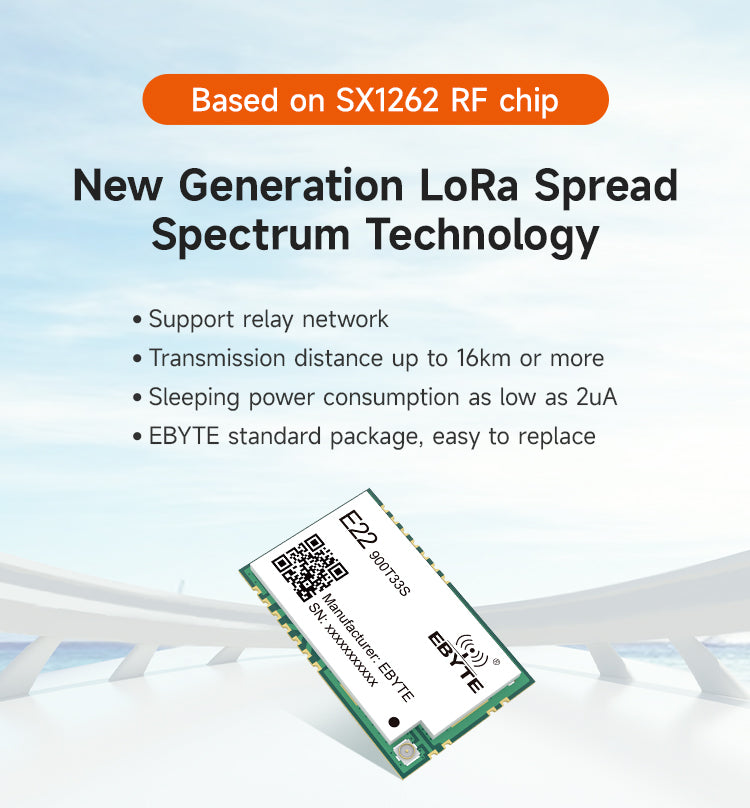
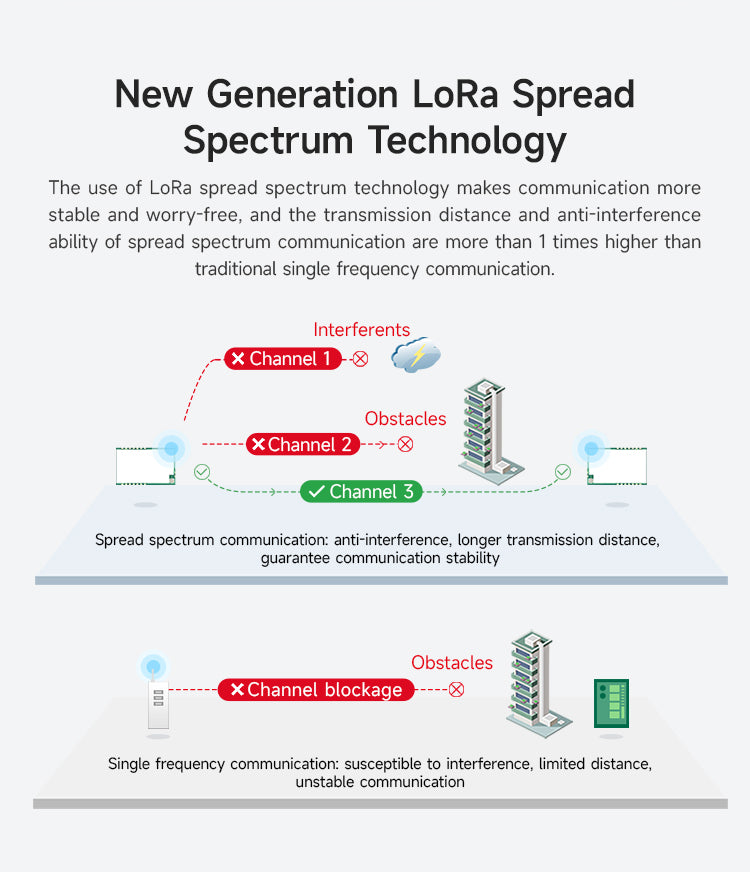
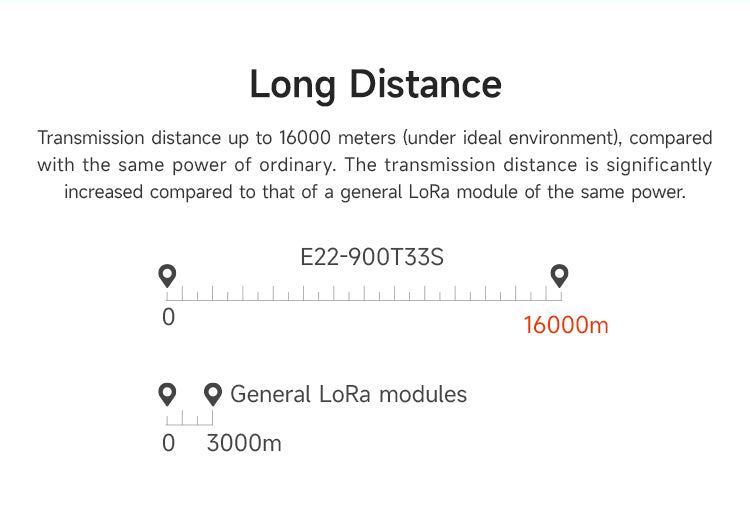
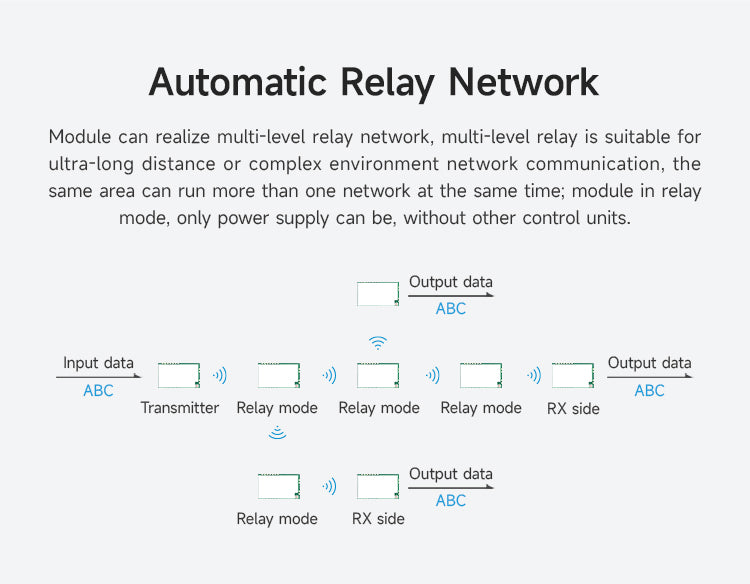
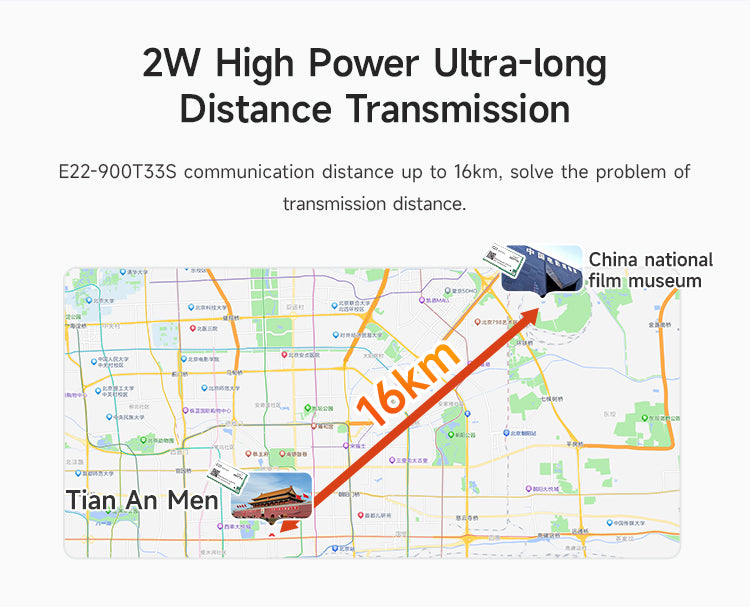
The E22-900T33S is a professional-grade 33dBm (2W) high-power wireless serial port module (UART) built on the Semtech SX1262 LoRa chip, delivering up to 16km long-range transmission with advanced relay networking and carrier monitoring capabilities.
| Main Parameter | Performance Details |
|---|---|
| Model | E22-900T33S |
| Chip Solution | SX1262 LoRa |
| Frequency Band | 850.125 ~ 930.125MHz (868/915MHz) |
| Transmit Power | 33dBm (approx. 2W) |
| Communication Distance | 16km (Open area, 2.4kbps) |
| Interface | UART Serial (TTL Level) |
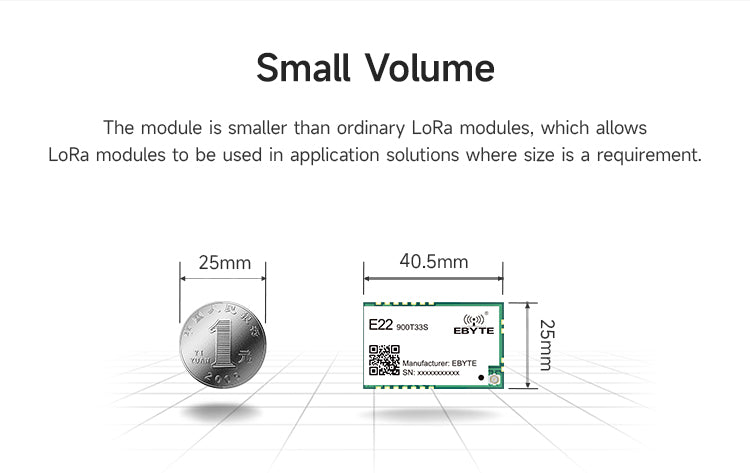
| Size | 25 * 40.5mm |

Technical Videos


Manual Download
Mannual
DEMO
3d file
PCB_Library
RF_Setting(E22-E9X(SL)) V3.0
Company Proflile
Main parameter
| Main parameter | performance | Remark | |||
| Minimum | Typical | Maximum | |||
| Working voltage (V) |
3.3 | 5 | 5.5 | ≥5.0V guaranteed output power | |
| Communication level (V) |
3.3 | There may be a risk of burning when using a 5V level | |||
| Working temperature (℃) |
-40 | - | 85 | industrial design | |
| Working frequency band (MHz) | 850.125 | - | 930.125 | Support ISM frequency band | |
| Consumption | Emission current (mA) | - | 610 | - | Instantaneous power consumption 033dBm |
| Receive current (mA) | - | 17 | - | - | |
| Sleep current (uA) | 4 | - | software shutdown | ||
| Maximum transmit power (dBm) | 32 | 33 | 34 | - | |
| Receiving sensitivity (dBm) | -123 | -124 | -125 | Air rate 2.4 kbps | |
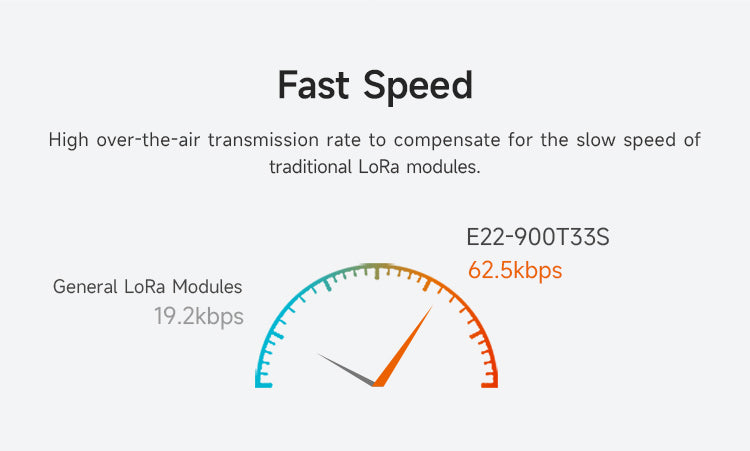
| Air rate (bps) | 2.4k | 2.4k | 62.5k | User Programmable Control | |
| Reference distance | 16km | Clear sky, antenna gain 5dBi, antenna height 2.5 meters, air rate 2.4kbps | |||
| launch length | 240 Byte | Subpackage 32/64/128/240 bytes can be sent by command setting | |||
| cache capacity | 1000 Byte | - | |||
| Modulation | L0Ra | A new generation of L0Ra modulation technology | |||
| Communication Interface | UART serial port | TTL level | |||
| Encapsulation | SMD | - | |||
| Interface | stamp hole | Stamp hole, pitch 2.54mm | |||
| Dimensions | 25*40.5 mm | - | |||
| RF interface | IPEX/stamp hole | Equivalent impedance about 50Ω | |||
Application
-
Rural Smart Irrigation Systems: Utilizing the 16km ultra-long transmission distance to cover vast farmlands. The SX1262's superior penetration solves the problem of high-density foliage signal attenuation where traditional WiFi or Bluetooth fails.
-
Industrial Automation Monitoring: Integrating into factory PLCs via the UART interface. The 33dBm high power ensures stable data packets even in environments with heavy metal structures and high electromagnetic interference.
-
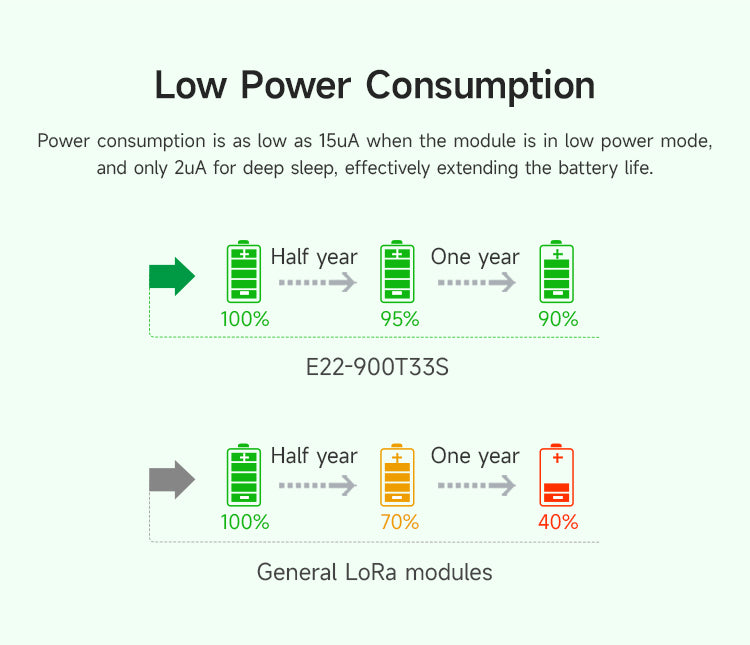
Solar Power Plant Management: Deploying the module for remote status reporting of inverters. The SX1262's improved low-power consumption extends battery life for off-grid sensors while providing reliable telemetry over long distances.
-
Oil & Gas Pipeline Telemetry: Leveraging the relay networking feature to extend signal coverage along hundreds of miles of pipeline, bypassing geographical obstacles through autonomous packet hopping.

Technical FAQ
Q: Why is a 5V power supply required to guarantee the 33dBm output power?
A: To reach the peak transmission power of 2W, the internal power amplifier requires a stable current flow and sufficient voltage headroom. When the supply voltage drops significantly below 5V, the efficiency of the RF power amplifier decreases, leading to a drop in effective isotropic radiated power and potential frequency pulling effects.
Q: How does the E22-900T33S handle IO level compatibility between 3.3V and 5V MCUs?
A: The module's UART interface is designed with a high-impedance buffer and clamping circuitry that allows the RX and TX pins to safely interface with both 3.3V and 5V logic families. This prevents the need for external level shifters which might introduce parasitic capacitance and signal propagation delays in high-speed serial communication.
Q: What are the specific power consumption benefits of the SX1262 over the SX1276 in this module?
A: The SX1262 architecture features an integrated high-efficiency DC-DC buck converter and a more optimized sleep state management unit. In receive mode, the current consumption is reduced by nearly 40 percent compared to the older generation, while the standby current remains as low as 4 microamps, significantly increasing the operational longevity of battery-powered end nodes.
Q: How does impedance matching at the IPEX/Stamp hole interface affect the 16km distance?
A: The RF output of the module is tuned for a standard 50 ohm characteristic impedance. Any mismatch at the antenna connection point creates a standing wave ratio that reflects power back into the module. For ultra-long range such as 16km, maintaining a low voltage standing wave ratio below 1.5 is critical to prevent thermal stress and ensure maximum energy transfer to the antenna.
